
Post-Quantum Secure Boot provides a Quantum-Resilient Hardware Root of Trust
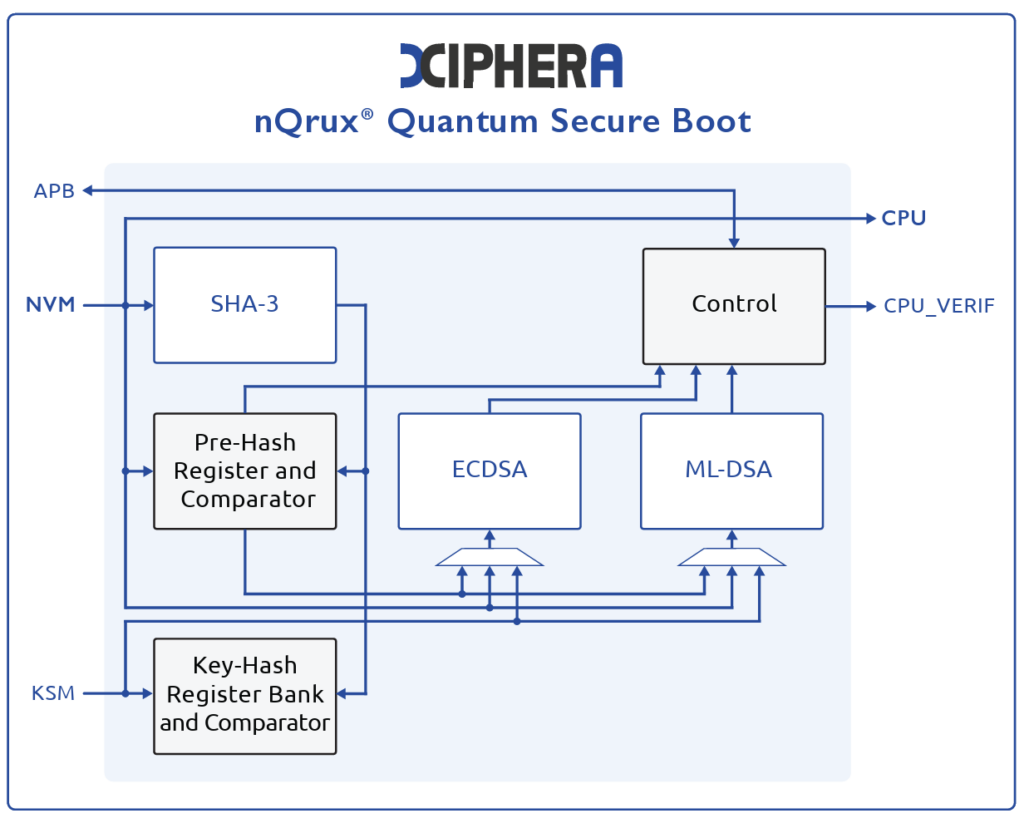
nQrux® Quantum Secure Boot authenticates all the code loaded to subdevices at start-up, using a hybrid ECDSA + ML-DSA signature scheme that is secure today and ready for the quantum era. The solution is based on pure hardware logic designed for implementation directly on ASICs.
What is quantum secure boot?
Secure boot is the mechanism that checks the integrity of a device’s software or digital assets before it is allowed to run. When a chip powers up, secure boot verifies that each image loaded during start-up — boot firmware, processor microcode, sensor configurations, and the components that come after — is authentic and unaltered. If something has been tampered with or corrupted, it is caught before it can run. Post-quantum secure boot refers to securing the boot using algorithms that quantum computers cannot break.
nQrux® Quantum Secure Boot is an authenticated boot: it guarantees the authenticity (the image genuinely came from who it should) and the integrity (the image has not changed) of everything it verifies. It protects against both deliberate tampering and accidental corruption.
Secure boot and the hardware root of trust
Secure boot is only as trustworthy as the very first thing that runs. That anchor is the root of trust: a small, trusted component that starts before everything else and vouches for what comes next, forming a chain of trust up through the system. nQrux® Quantum Secure Boot is designed to be that anchor — one of the first components to start, verifying each subsequent stage so trust is established from the very first cycle. Because it is implemented directly in hardware, the root of trust cannot be bypassed or modified in the field.
Why secure boot must be quantum-safe
The threat to signed firmware and long-lived devices
Secure boot relies on digital signatures. The signature schemes protecting most devices today are the ones a future quantum computer could break. This is especially significant for hardware devices with long deployment cycles: a device shipped now may stay in the field for decades, and its boot security has to hold throughout the entire life span.
The stakes are highest in critical systems. If an attacker can alter what a device loads at boot, they can make it report false data or stop working altogether — and, most seriously, compromise the root of trust itself, so that every other security measure built on top of it is rendered worthless.
Quantum-safe boot authentication ensures that only genuine, unaltered software runs, now and once stable and cryptographically-relevant quantum computers arrive.
Why a hybrid ECDSA + ML-DSA scheme
nQrux® Quantum Secure Boot verifies signatures with two algorithms at once: classical ECDSA and post-quantum ML-DSA. ECDSA rests on more than twenty years of proven, well-understood mathematics; ML-DSA protects against the quantum threat that classical schemes cannot withstand. Run together, each covers the other’s risk. If a quantum computer ever breaks the classical algorithm, ML-DSA still stands; if an as-yet-undiscovered weakness were found in the newer scheme, the proven classical one holds.
The cost of running both methods in parallel is marginal and the extra computation happens only once, at boot. The hybrid configuration is the smartest choice for most applications, and EU regulation even recommends it.
Why post-quantum secure boot belongs in hardware
nQrux® Quantum Secure Boot is a pure hardware implementation: fixed digital logic, with no CPU, no processor core, and not a single line of software inside. For a root of trust, that is a fundamental security property, not a detail.
With no software component, there is no embedded firmware to patch and no update mechanism for an attacker to subvert. The behaviour is fixed in the design and deterministic. And because there is no software cryptography in the device, the customer’s design is significantly easier to certify. The core is compact and its power consumption is low. The principle has made dedicated hardware security standard across critical infrastructure, especially when applied to the boot process.
Where the nQrux® Quantum Secure Boot can be used
Space and mission-critical systems. The core was developed in a project with the European Space Agency and a manufacturer of space-grade processors as the lead customer. Every piece of data booted from the processor passes through secure boot and is authenticated before it runs.
Critical infrastructure. Energy, industrial, and transport systems share the same pattern: something is booted from data that must be authenticated first. Secure boot is often mandatory as firmware tampering or injection of malicious firmware can have severe consequences in the physical world.
Connected and surveillance devices. In a networked camera, for example, secure boot prevents an attacker from swapping in altered firmware to hijack the device or view its stream without authorisation.
Trusted computing and custom silicon. Any ASIC that needs a verifiable, tamper-resistant start-up sequence can use the core as its root of trust.
nQrux® Quantum Secure Boot IP core
Core features:
- Authenticated boot: digital-signature verification of boot images and binaries
- Hybrid signature scheme — classical ECDSA and post-quantum ML-DSA
- Implements NIST standard FIPS 204 for quantum-secure digital signatures
- A secure cryptographic base for a hardware root of trust
- Pure hardware logic — no CPU or software components
- Side-channel attack resistance
- Easy integration via a 32-bit interface
- Designed for ASICs and SOCs
- Supports FPGA implementations
Moderate footprint
The Balanced Secure Boot core supports all security levels
- ECDSA-256/384/521 and ML-DSA-44/65/87
- In a moderate footprint capable of thousands of signature verifications per second.
Product brief
Learn more about the key features and functionalities of nQrux® Quantum Secure Boot IP core.
Resource sheet
Download the resource sheet to learn more about the FPGA and ASIC resource requirements and performance.
How is the solution delivered and integrated
Xiphera’s cores are delivered as Hardware Description Language (HDL), i.e. as a description from which your chip’s logic is built. It is supplied as encrypted RTL, which integrates into your design without exposing or allowing changes to the source; a cleartext, modifiable version is available if you need to adapt it. Delivery is straightforward: after commercial terms, you download the code directly.
Every delivery includes a year of support and maintenance, integration help included. Integrations are generally smooth, and where issues arise we help resolve them.
Proven in space, trusted in critical systems
nQrux® Quantum Secure Boot was created in a collaboration project with the European Space Agency and has since been implemented in designs across space and critical-infrastructure applications. It is an established, production-ready core built on algorithms that Xiphera has worked with during the NIST post-quantum standardisation process.
Why customers choose Xiphera
Every Xiphera core is designed and built in-house by our team in Finland and handcrafted to the cryptographic standards, never acquired from third parties and never AI-generated. That combination of deep cryptographic knowledge and semiconductor expertise is what we offer.
What sets us apart is how we work: close, responsive support and the ability to tailor the core and the project to your design. You work directly with the engineers who built the product.
Build your quantum-safe root of trust with Xiphera
Whether you are scoping an ASIC that needs a tamper-proof boot-up sequence or evaluating post-quantum options for a long-life design, our cryptography engineers can help — and you can evaluate the core against your own requirements and design before you commit.
Complete your root of trust
Hardware solutions typically require further security mechanisms in addition to Secure Boot. Because nQrux® Quantum Secure Boot is built from Xiphera’s own cryptographic primitives, it fits naturally with the rest of the portfolio. The ML-DSA and ECDSA cores it relies on are also available separately, alongside the SHA-3 hashing, encryption, and true random number generation (TRNG) that most secure chips need. Our team supports in integrating and optimising the core to fit your designs and needs.

Quantum secure boot — frequently asked questions
What is secure boot?
Secure boot verifies a device’s digital asset at start-up, so only authentic, unaltered images are allowed to run. nQrux® Quantum Secure Boot performs authenticated boot: it checks the authenticity and integrity of everything the device loads, from boot firmware to processor microcode.
What is a root of trust?
The root of trust is the first, trusted component to run when a device powers up. It vouches for the next stage, which vouches for the next, forming a chain of trust through the whole system. Implemented in hardware, it cannot be bypassed or altered in the field.
Is secure boot quantum-safe?
Most secure boot today relies on RSA or ECC signatures, which a future quantum computer could break. nQrux® Quantum Secure Boot uses a hybrid scheme that combines classical ECDSA plus post-quantum ML-DSA (FIPS 204) so it is secure now and remains secure once stable and cryptographically relevant quantum computers arrive.
Why a hybrid ECDSA + ML-DSA scheme?
Running both means each covers the other’s risk: the proven classical algorithm and the quantum-resistant one. The overhead of adding quantum resilience is marginal. As the verification runs only at boot, the impact on boot times is minimal.
Is this for ASIC or FPGA?
The core is designed for ASIC implementations. If you are targeting an FPGA, talk to us first so we can confirm the fit for your case.
Does it encrypt the boot images too?
The standard configuration of the IP core provides authenticity and integrity. If the design requires boot-image confidentiality, we can provide that as well.
How is it delivered?
The standard delivery option is an encrypted RTL (Hardware Description Language). Source-code delivery is also available at separate cost. Both options include 12 months of support and maintenance.